 |
| Rivista di Massoneria - Revue de Franc-Maçonnerie - Revista de Masonerìa - Revista de Maçonaria |
|---|
| History Literature Music Art Architecture Documents Rituals Symbolism |

|
|
| Rivista di Massoneria - Revue de Franc-Maçonnerie - Revista de Masonerìa - Revista de Maçonaria |
|---|
| History Literature Music Art Architecture Documents Rituals Symbolism |
|
|

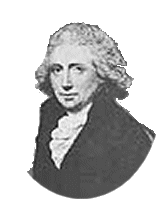
by WILLIAM PRESTON (1742-1818) Past Master of the Lodge of Antiquity The Twelth Edition, London. 1812 |
|
BOOK II.
GENERAL REMARKS: INCLUDING AN ILLUSTRATION OF THE LECTURES; A PARTICULAR DESCRIPTION OF THE ANCIENT CEREMONIES; AND THE CHARGES USED IN THE DIFFERENT DEGREES.
SECT. I. General Remarks.
MASONRY is an art useful and extensive. In every art there is a mystery which requires a progress of study and application before we can arrive at any degree of perfection. Without much instruction, and more exercise, no man can be skilful in any art; in like manner, without an assiduous application to the various subjects treated in the different lectures of Masonry, no person can be sufficiently acquainted with the true value of the institution. From this remark it is not to be inferred, that those who labour under the disadvantage of a confined education, or whose sphere of life requires assiduous attention to business or useful employments, are to be discouraged in their endeavours to gain a knowledge of Masonry. To qualify an individual to enjoy the benefits of the society at large, or to partake of its privileges, it is not absolutely necessary that he should be acquainted with all the intricate parts of the science. These are only intended for persons who may have leisure and opportunity to indulge the pursuit. Some may be more able than others, some more eminent, some more useful; but all in their different spheres, may prove advantageous to the community; and our necessities, as well as our consciences, bind us to love one another. To persons, however, whose early years have been dedicated to literary pursuits, or whose circumstances and situation in life render them independent, the offices of the lodge ought principally to be restricted. The industrious tradesman proves himself a valuable member of society, and worthy of every honour that we can confer; but the nature of every man's profession will not admit of that leisure which is necessary to qualify him to become an expert Mason, so as to discharge the official duties of the lodge with propriety. And it must also be admitted, that those who accept offices and exercise authority in the lodge, ought to be men of prudence and address, enjoying the advantages of a well-cultivated mind and retentive memory. All men are not blessed with the same powers and talents; all men, therefore, are not equally qualified to govern. He who wishes to teach, must submit to learn; and no one can be qualified to support the higher offices of the lodge who has not previously discharged the duties of those which are subordinate. Experience is the best preceptor. Every man may rise by gradation, but merit and industry are the first steps to preferment. Masonry is wisely instituted for different ranks and degrees of men; and every brother, according to his station and ability, may be employed in the lodge, and class with his equal. Actuated by the best principles, no disquietude is found among the professors of the art. Each class is happy in its particular association; and when all the classes meet in general convention, one plan regulates the whole; neither arrogance nor presumption appears on the one hand, nor diffidence nor inability on the other; every brother vies to excel in promoting that endearing happiness which constitutes the essence of civil society.
The Ceremony of Opening and Closing the Lodge.
In all regular assemblies of men which are convened for wise and useful purposes, the commencement and conclusion of business is accompanied with some form. In every country of the world the practice prevails, and is deemed essential. From the most remote periods of antiquity it is traced, and the refined improvements of modern times have not abolished it. Ceremonies, simply considered, are little more than visionary delusions; but their effects are sometimes important.— When they impress awe and reverence on the mind, and attract the attention to solemn rites by external forms, they are interesting objects. These purposes are effected when judicious ceremonies are regularly conducted and properly arranged. On this ground they have received the sanction of the wisest men in all ages, and consequently could not escape the notice of Masons. To begin well, is the most likely means to end well; and it is justly remarked, that when order and method are neglected at the beginning, they will be seldom found to take place at the end. The ceremony of opening and closing the lodge with solemnity and decorum is therefore universally adopted among Masons; and though the mode in some meetings may vary, and in every Degree must vary, still a uniformity in the general practice prevails in the lodge; and the variation (if any) is solely occasioned by a want of method, which a little application will easily remove. To conduct this ceremony with propriety, ought to be the peculiar study of every Mason, especially of those who have the honour to rule in our assemblies. To persons who are thus dignified, every eye is directed for regularity of conduct and behaviour; and by their example, other brethren, less informed, may naturally expect to derive instruction. From a share in this ceremony no Mason is exempted; it is a general concern, in which all must assist. This is the first request of the Master and the prelude to business. No sooner has it been signified, than every officer repairs to his station, and the brethren rank according to their degrees. The intent of the meeting becomes the object of attention; and the mind is insensibly drawn from the indiscriminate subjects of conversation which are apt to intrude on our less serious moments. Our first care is directed to the external avenues of the lodge, and the proper officers, whose province it is to discharge that duty, execute the trust with fidelity. By certain mystic forms, of no recent date, it is intimated that we may safely proceed. To detect impostors among ourselves, an adherence to order in the character of Masons ensues, and the lodge is opened or closed in solemn form. At opening the lodge, two purposes are effected: the Master is reminded of the dignity of his character, and the brethren of the homage and veneration due to him in their sundry stations. These are not the only advantages resulting from a due observance of the ceremony; a reverential awe for the Deity is inculcated, and the eye is fixed on that object from whose radiant beams alone light can be derived. Hence, in this ceremony, we are taught to adore God, and supplicate his protection on our well-meant endeavours. The Master assumes his government in due form, and under him his Wardens; who accept their trust, after the customary salutations. Then the brethren, with one accord, unite in duty and respect, and the ceremony concludes. At closing the lodge, a similar form takes place. Here the less important duties of the Order are not passed unobserved. The necessary degree of subordination which takes place in the government of the lodge is peculiarly marked, while the proper tribute of gratitude is offered up to the beneficent Author of life, whose blessing is invoked, and extended to the whole fraternity. Each brother then faithfully locks up the treasure which he has acquired in his own repository; and, pleased with his reward, retires to enjoy, and disseminate among the private circle of his friends, the fruits of his labour and industry in the lodge. These are faint outlines of a ceremony which universally prevails among Masons, and distinguishes all their meetings. Hence, it is arranged as a general Section in every Degree of the Order, and takes the lead in all our illustrations.
A Prayer used at opening the Lodge. May the favour of Heaven be upon this meeting! And as it is happily begun, may it be conducted in order, and closed in harmony! Amen.
A Prayer used at closing the Lodge. May the blessing of Heaven rest upon us, and all regular Masons! May brotherly love prevail, and every moral and social virtue cement us! Amen.
Charges and Regulations for the conduct and behaviour of Masons. A rehearsal of the Ancient Charges properly succeeds the opening, and precedes the closing, of the lodge. This was the constant practice of our ancient brethren, and ought never to be neglected in our regular assemblies. A recapitulation of our duty cannot be disagreeable to those who are acquainted with it; and to those to whom it is not known, should any such be, it must be highly proper to recommend it.
Ancient Charges. [To be rehearsed at opening the Lodge.] On the Management of the Craft in working.
Masons employ themselves diligently in their sundry vocations live creditably, and conform with cheerfulness to the government of the country in which they reside. The most expert craftsman is chosen or appointed Master of the work, and is duly honoured in that character by those over whom he presides. The Master, knowing himself qualified, undertakes the government of the lodge, and truly dispenses his rewards, according to merit. A craftsman who is appointed Warden of the work under the Master, is true to Master and Fellows, carefully oversees the work, and the brethren obey him. The Master, Wardens, and brethren are just and faithful, and carefully finish the work they begin, whether it be in the First or Second Degree; but never put that work to the First, which has been appropriated to the Second Degree. Neither envy nor censure is discovered among Masons. No brother is supplanted, or put out of his work, if he be capable to finish it; for he who is not perfectly skilled in the original design, can never with equal advantage to the Master finish the work begun by another. All employed in Masonry meekly receive their rewards, and use no disobliging name. Brother or Fellow are the appellations they bestow on each other. They behave courteously within and without the lodge, and never desert the Master till the work is finished.[1]
Laws for the Government of the Lodge. [To be rehearsed at opening the Lodge.]
You are to salute one another in a courteous manner, agreeably to the forms established among Masons[2] ; you are freely to give such mutual instructions as shall be thought necessary or expedient, not being overseen or overheard, without encroaching upon each other, or derogating from that respect which is due to a gentleman were he not a Mason; for though as Masons we meet as brethren on a level, yet Masonry deprives no man of the honour due to his rank or character, but rather adds to his honour, especially if he has deserved well of the Fraternity, who always render honour to whom it is due, and avoid ill-manners. No private committees are to be allowed, or separate conversations encouraged: the Master or Wardens are not to be interrupted, or any brother who is speaking to the Master; but due decorum is to be observed, and a proper respect paid to the Master, and presiding officers. These laws are to be strictly enforced, that harmony may be preserved, and the business of the lodge carried on with order and regularity. Amen. So mote it be.
Charge on the Behaviour of Masons. [To be rehearsed at closing the Lodge.]
When the lodge is closed, you are to enjoy yourselves with innocent mirth, and carefully avoid excess. You are not to compel any brother to act contrary to his inclination, or give offence by word or deed, but enjoy a free and easy conversation. You are to avoid immoral or obscene discourse, and at all times support with propriety the dignity of your character. You are to be cautious in your words and carriage, that the most penetrating stranger may not discover, or find out, what is not proper to be intimated; and, if necessary, you are to wave the discourse, and manage it prudently, for the honour of the fraternity. At home, and in your several neighbourhoods, you are to behave as wise and moral men. You are never to communicate, to your families, friends, or acquaintances, the private transactions of our different assemblies; but, on every occasion, consult your own honour, and the reputation of the fraternity at large. You are to study the preservation of health, by avoiding irregularity and intemperance, that your families may not be neglected and injured, or yourselves disabled from attending to your necessary employments in life. If a stranger apply in the character of a Mason, you are cautiously to examine him in such a method as prudence may direct, and agreeably to the forms established among Masons; that you may not be imposed upon by an ignorant false pretender, whom you are to reject with contempt;[3] and beware of giving him any secret hints of knowledge. But if you discover him to be a true and genuine brother, you are to respect him; if he be in want, you are without prejudice to relieve him, or direct him how he may be relieved; you are to employ him, or recommend him to employment: however, you are never charged to do beyond your ability, only to prefer a poor Mason, who is a good man and true, before any other person in the same circumstances.[4] Finally, These rules you are always to observe and enforce, and also the duties which have been communicated in the lecture; cultivating brotherly love, the foundation and cape-stone, the cement and glory of this ancient fraternity; avoiding, on every occasion, wrangling and quarrelling, slandering and backbiting; not permitting others to slander honest brethren, but defending their characters, and doing them good offices, as far as may be consistent with your honour and safety, but no farther. Hence all may see the benign influence of Masonry, as all true Masons have done from the beginning of the world, and will do to the end of time. Amen. So mote it be.
Remarks on the First Lecture.
Having illustrated the ceremony of opening and closing the lodge, and inserted the Prayers and Charges usually rehearsed in our regular assemblies on those occasions, we shall now enter on a disquisition of the different Sections of the Lectures which are appropriated to the three Degrees of the Order, giving a brief summary of the whole, and annexing to every Remark the particulars to which the Section alludes. By these means the industrious Mason will be better instructed in the regular arrangement of the Lectures, and be enabled with more ease to acquire a competent knowledge of the Art. The First Lecture is divided into Sections, and each Section is subdivided into Clauses. In this Lecture, virtue is painted in the most beautiful colours, and the duties of morality are strictly enforced. Here we are taught such wise and useful lessons as prepare the mind for a regular advancement in the principles of knowledge and philosophy; and these are imprinted on the memory by lively and sensible images, well calculated to influence our conduct in the proper discharge of the duties of social life.
The First Section.
The first Section of this Lecture is suited to all capacities, and ought to be known by every person who wishes to rank as a Mason. It consists of general heads, which, though they be short and simple, will be found to carry weight with them. They not only serve as marks of distinction, but communicate useful and interesting knowledge when they are duly investigated. They qualify us to try and examine the rights of others to our privileges, while they demonstrate our own claim; and as they induce us to inquire minutely into other particulars of great importance, they serve as a proper introduction to subjects which are more amply explained in the following Sections. As we can annex to this remark no other explanation consistent with the rules of Masonry, we must refer the more inquisitive to our regular assemblies for farther instruction.
The Second Section.
The Second Section makes us acquainted with the peculiar forms and ceremonies which are adopted at the initiation of candidates into Masonry; and convinces us beyond the power of contradiction, of the propriety of our rites; whilst it demonstrates to the most sceptical and hesitating mind their excellence and utility. The following particulars relative to the ceremony of initiation may be introduced here with propriety:
The Declaration to be assented to by every Candidate previous to Initiation.
'Do you seriously declare, upon your honour, before these gentlemen[5], that, unbiased by friends against your own inclination, and uninfluenced by mercenary motives, you freely and voluntarily offer yourself a candidate for the mysteries of Masonry?' —-I do. 'Do you seriously declare, upon your honour, before these gentlemen, that you are solely prompted to solicit the privileges of Masonry, by a favourable opinion conceived of the institution, a desire of knowledge, and a sincere wish of being serviceable to your fellow-creatures?' —- I do. 'Do you seriously declare, upon your honour, before these gentlemen, that you will cheerfully conform to all the ancient established usages and customs of the Order?' — I do. The Candidate is then proposed in open lodge, as follows: 'R.W. Master, and Brethren, At the request of Mr. A.B. [mentioning his profession and residence] I propose him in form as a proper Candidate for the mysteries of Masonry; I recommend him, as worthy to share the privileges of the Fraternity; and, in consequence of a Declaration of his intentions, voluntarily made and properly attested, I believe he will strictly conform to the rules of the Order.' The Candidate is ordered to be prepared for Initiation.
A Prayer used at Initiation.
Vouchsafe thine aid, Almighty Father of the Universe, to this our present convention! and grant that this Candidate for Masonry may dedicate and devote his life to thy service, and become a true and faithful Brother among us! Endue him with a competency of thy divine wisdom; that, by the secrets of this Art, he may be the better enabled to display the beauties of godliness, to the honour of thy holy Name! Amen. Note: It is a duty incumbent on the Master of the lodge, before the ceremony of initiation takes place, to inform the Candidate of the purpose and design of the institution; to explain the nature of his solemn engagements; and, in a manner peculiar to Masons, to require his cheerful acquiescence to the tenets of the Order.
The Third Section.
The Third Section, by the reciprocal communication of our marks of distinction, proves the regularity of our initiation; and inculcates those necessary and instructive duties which dignify our character in the double capacity of Men and Masons. We cannot better illustrate this Section, than by inserting the following:
Charge at Initiation into the First Degree.[6]
BROTHER, [As you are now introduced into the first principles of our Order, it is my duty to congratulate you, on being accepted a Member of an ancient and honourable Society; ancient, as having subsisted from time immemorial; and honourable, as tending, in every particular, so to render all men who will be conformable to its precepts. No institution was ever raised on a better principle, or more solid foundation; nor were ever more excellent rules and useful maxims laid down, than are inculcated on every person when he is initiated into our mysteries. Monarchs in all ages have been encouragers and promoters of the Art, and have never deemed it derogatory from their dignities, to level themselves with the brethren, to extend their privileges, and to patronise their assemblies.] As a Mason, you are to study the moral law, as it is contained in the sacred code[7]; to consider it as the unerring standard of truth and justice, and to regulate your life and actions by its divine precepts. The three great moral duties, to God, your neighbour, and yourself, you are strictly to observe:— To God, by holding his name in awe and veneration; viewing him as the chief good, imploring his aid in laudable pursuits, and supplicating his protection on well-meant endeavours: — To your neighbour, by acting upon the square, and, considering him equally entitled with yourself to share the blessings of Providence, rendering unto him those favours, which in a similar situation you would expect to receive from him:— And to yourself, by not abusing the bounties of Providence, impairing the faculties by irregularity, or debasing the profession by intemperance. In the state, you are to be a quiet and peaceable subject, true to your sovereign, and just to your country; you are not to countenance disloyalty or rebellion, but patiently submit to legal authority, and conform with cheerfulness to the government under which you live; yielding obedience to the laws which afford you protection, and never forgetting the attachment you owe to the place of your nativity, or the allegiance due to the sovereign or protectors of that spot. [In your outward demeanour you are to avoid censure or reproach; and beware of all who may artfully endeavour to insinuate themselves into your esteem with a view to betray your virtuous resolutions, or make you swerve from the principles of the institution. Let not interest, favour, or prejudice, bias your integrity, or influence you to be guilty of a dishonourable action; but let your conduct be uniform, and your deportment suitable to the dignity of the profession.] Above all, practice benevolence and charity; for these virtues have distinguished Masons in every age and country. [The inconceivable pleasure of contributing toward the relief of our fellow-creatures, is truly experienced by persons of a humane disposition; who are naturally excited, by sympathy, to extend their aid in alleviation of the miseries of others. This encourages the generous Mason to distribute his bounty with cheerfulness; by supposing himself in the situation of an unhappy sufferer, he listens to the tale of woe with attention, bewails misfortune, and speedily relieves distress.] The Constitutions of the Order are next to engage your attention. [These consist of two points, oral and written communication. The former comprehends the mysteries of the Art, and are only to be acquired by practice and experience in the lodge; the latter includes the history of genuine Masonry, the lives and characters of its patrons, and the ancient charges and general regulations of the Craft.] A punctual attendance on the duties of the Order we earnestly enjoin, more especially in that assembly where your name is enrolled as a member. [There, and in all regular meetings of the fraternity, you are to behave with order and decorum, that harmony may be preserved, and the business of Masonry properly conducted. The rules of good-breeding you are never to violate, by using unbecoming language, in derogation of the name of God, or toward the corruption of good manners: neither are you to enter into any dispute about religion or politics; or behave irreverently, while the lodge is engaged in what is serious and important.] On every occasion you are to pay a proper deference and respect to the Master and presiding officers, and diligently apply to the work of Masonry, that you may sooner become a proficient therein, as well for your own credit, as the honour of the company with whom you associate. Although your frequent appearance at our regular meetings be earnestly solicited, your necessary employments are not to be neglected on that account: neither are you to suffer your zeal for Masonry to exceed the bounds of discretion, or lead you into argument with persons who may ridicule our system; but extend your pity toward those who may be apt through ignorance to contemn, what they never had an opportunity to comprehend. All that is required for your general observance is, that you study the liberal arts at leisure, trace science in the works of eminent masters, and improve in the disquisitions of the system, by the conversation of well-informed brethren, who will be equally ready to give, as you can be to receive, instruction. Finally; Adhere to the constitutions, and support the privileges which are to distinguish you as a Mason above the rest of the community, and mark your consequence among the Fraternity. If, in the circle of your acquaintance, you find a person desirous of being initiated into the Order, be particularly attentive not to recommend him, unless you are convinced he will conform to our rules; that the value of Masonry may be enhanced by the difficulty of the purchase; the honour and reputation of the institution established on the firmest basis; and the world at large convinced of its benign influence. [From the attention you have paid to the recital of the duties of the Order, we are led to hope that you will form a proper estimate of the value of Free-masonry, and imprint on your mind the dictates of truth, honour, and justice.] This section usually closes with the following
EULOGIUM. Masonry comprehends within its circle every branch of useful knowledge and learning, and stamps an indelible mark of pre-eminence on its genuine professors, which neither chance, power, nor fortune, can bestow. When its rules are strictly observed, it is a sure foundation of tranquillity amid the various disappointments of life; a friend that will not deceive, but will comfort and assist, in prosperity and adversity; a blessing, that will remain with all time, circumstances, and places; and to which recourse may be had, when other earthly comforts sink in disregard. Masonry gives real and intrinsic excellency to man, and renders him fit for the duties of society. It strengthens the mind against the storms of life, paves the way to peace, and promotes domestic happiness. It meliorates the temper, and improves the understanding; it is company in solitude, and gives vivacity, variety, and energy to social conversation. In youth, it governs the passions, and employs usefully our most active faculties; and in age, when sickness, imbecility, and disease, have benumbed the corporeal frame, and rendered the union of soul and body almost intolerable, it yields an ample fund of comfort and satisfaction. These are its general advantages; to enumerate them separately, would be an endless labour: it may be sufficient to observe, that he who cultivates this science, and acts agreeably to the character of a Mason, has within himself the spring and support of every social virtue; a subject of contemplation, that enlarges the mind, and expands all its powers; a theme that is inexhaustible, ever new, and always interesting.
The Fourth Section.
The Fourth Section rationally accounts for the origin of our hieroglyphical instruction, and points out the advantages which accompany a faithful observance of our duty; it illustrates, at the same time, certain particulars, our ignorance of which might lead us into error; and which, as Masons, we are indispensably bound to know. To make daily progress in the Art, is a constant duty, and expressly required by our general laws. What end can be more noble, than the pursuit of virtue? what motive more alluring, than the practice of justice? or what instruction more beneficial, than an accurate elucidation of symbols which tend to improve and embellish the mind? Every thing that strikes the eye more immediately engages the attention, and imprints on the memory serious and solemn truths. Masons have therefore universally adopted the plan of inculcating the tenets of their order by typical figures and allegorical emblems, to prevent their mysteries from descending within the familiar reach of inattentive and unprepared novices, from whom they might not receive due veneration. The usages and customs of Masons have ever corresponded with those of the ancient Egyptians; to which they bear a near affinity. Those philosophers, unwilling to expose their mysteries to vulgar eyes, concealed their particular tenets and principles of polity and philosophy under hieroglyphical figures; and expressed their notions of government by signs and symbols, which they communicated to their Magi alone, who were bound by oath never to reveal them. Pythagoras seems to have established his system on a similar plan; and many Orders of a more recent date have copied the example. Masonry, however, is not only the most ancient, but the most moral Institution that ever subsisted; as every character, figure, emblem, depicted in the lodge, has a moral tendency, and tends to inculcate the practice of virtue.
The Fifth Section.
The Fifth Section explains the nature and principles of our constitution, and teaches us to discharge with propriety the duties of the different departments which we are appointed to sustain in the government of the lodge. Here, too, our ornaments are displayed, and our jewels and furniture specified; while a proper attention is paid to our antient and venerable patrons. To explain the subjects treated in this Section, and assist the industrious Mason to acquire them, we can only recommend a punctual attendance on the duties of the lodge, and a diligent application to the lessons which are there inculcated.
The Sixth Section.
The Sixth Section, though the last in rank, is not the least considerable in importance. It strengthens those which precede, and enforces, in the most engaging manner, a due regard to character and behaviour, in public as well as in private life, in the lodge as well as in the general commerce of society. This Section forcibly inculcates the most instructive lessons. Brotherly Love, Relief, and Truth, are themes on which we here expatiate.—By the exercise of Brotherly Love we are taught to regard the whole human species as one family, the high and low, the rich and poor; who, as children of the same Parent, and inhabitants of the same planet, are to aid, support, and protect each other. On this principle, Masonry unites men of every country, sect, and opinion; and conciliates true friendship among those who might otherwise have remained at a perpetual distance.—Relief is the next tenet of the profession. To relieve the distressed is a duty incumbent on all men, particularly on Masons, who are linked together by an indissoluble chain of sincere affection. To soothe calamity, alleviate misfortune, compassionate misery, and restore peace to the troubled mind, is the grand aim of the true Mason. On this basis he establishes his friendships, and forms his connections.— Truth is a divine attribute, and the foundation of every virtue. To be good men and true, is the first lesson we are taught in Masonry. On this theme we contemplate, and by its dictates endeavour to regulate our conduct: influenced by this principle, hypocrisy and deceit are unknown in the lodge, sincerity and plain-dealing distinguish us; while the heart and tongue join in promoting the general welfare, and rejoicing in each other's prosperity. To this illustration succeeds an explanation of the four cardinal virtues, Temperance, Fortitude, Prudence, and Justice. — By Temperance, we are instructed to govern the passions, and check unruly desires. The health of the body, and the dignity of the species, are equally concerned in a faithful observance of it. — By Fortitude, we are taught to resist temptation, and encounter danger with spirit and resolution. This virtue is equally distant from rashness and cowardice; and he who possesses it, is seldom shaken, and never overthrown, by the storms that surround him. —By Prudence, we are instructed to regulate our conduct by the dictates of reason, and to judge and determine with propriety in the execution of everything that tends to promote either our present or future well-being. On this virtue, all others depend; it is, therefore, the chief jewel that can adorn the human frame. — Justice, the boundary of right, constitutes the cement of civil society. This virtue, in a great measure, constitutes real goodness, and is therefore represented as the perpetual study of the accomplished Mason. Without the exercise of justice, universal confusion would ensue; lawless force might overcome the principles of equity, and social intercourse no longer exist. The explanation of these virtues is accompanied with some general observations on the equality observed among Masons. In the lodge, no estrangement of behaviour is discovered; influenced by the same principle, a uniformity of opinion, which is useful in exigencies, and pleasing in familiar life, universally prevails, strengthens the ties of friendship, and promotes love and esteem. Masons are brethren by a double tie; and among them, as brothers, no invidious distinctions exist; merit being always respected, and honour rendered to whom honour is due. —A king, in the lodge, is reminded, that although a crown may adorn the head, or a sceptre the hand, the blood in the veins is derived from the common parent of mankind, and is no better than that of the meanest subject. — The statesman, the senator, and the artist, are there taught that, equally with others, they are, by nature, exposed to infirmity and disease; and that an unforeseen misfortune, or a disordered frame, may impair their faculties, and level them with the most ignorant of their species. This checks pride, and incites courtesy of behaviour. — Men of inferior talents, or who are not placed by fortune in such exalted stations, are instructed to regard their superiors with peculiar esteem, when they discover them voluntarily divested of the trappings of external grandeur, and condescending, in the badge of innocence and bond of friendship, to trace wisdom and follow virtue, assisted by those who are of a rank beneath them. Virtue is true nobility, and wisdom is the channel by which virtue is directed and conveyed; Wisdom and Virtue only mark distinction among Masons. Such is the arrangement of the Sections in the First Lecture, which, including the forms adopted at opening and closing the lodge, comprehends the whole of the First Degree. This plan has not only the advantage of regularity to recommend it, but the support of precedent and authority, and the sanction and respect which flow from antiquity. The whole is a regular system of morality, conceived in a strain of interesting allegory, which readily unfolds its beauties to the candid and industrious inquirer.
Remarks on the Second Lecture.
MASONRY is a progressive science, and is divided into different classes or Degrees, for the more regular advancement in the knowledge of its mysteries. According to the progress we make, we limit or extend our inquiries; and, in proportion to our talents, we attain to a lesser or greater degree of perfection. Masonry includes almost every branch of polite learning under the veil of its mysteries, which comprehend a regular system of science. Many of its illustrations may appear unimportant to the confined genius; but the man of more enlarged faculties will consider them in the highest degree useful and interesting. To please the accomplished scholar and ingenious artist, the institution is planned; and in the investigation of its latent doctrines, the philosopher and mathematician may experience equal satisfaction and delight. To exhaust the various subjects of which Masonry treats, would transcend the powers of the brightest genius: still, however, nearer approaches to perfection may be made, and the man of wisdom will not check the progress of his abilities, though the task he attempts may at first seem insurmountable. Perseverance and application will remove each difficulty as it occurs; every step he advances, new pleasures will open to his view, and instruction of the noblest kind attend his researches. In the diligent pursuit of knowledge, great discoveries are made; and the intellectual faculties are wisely employed in promoting the glory of God, and the good of man. Such is the tendency of all the illustrations in masonry. Reverence for the Deity, and gratitude for the blessings of heaven, are inculcated in every Degree. This is the plan of our system, and the result of our inquiries. The First Degree being intended to enforce the duties of morality, and imprint on the memory the noblest principles which can adorn the human mind; the Second Degree extends the plan, and comprehends a more diffusive system of knowledge. Practice and theory are united to qualify the industrious Mason to share the pleasures which an advancement in the Art necessarily affords. Listening with attention to the wise opinions of experienced men on important subjects, the mind of the Craftsman is gradually familiarised to useful instruction, and he is soon enabled to investigate truths of the utmost concern in the general transactions of life. From this system proceeds a rational amusement. While the mental powers are fully employed, the judgment is properly exercised: a spirit of emulation prevails; and every brother vies, who shall most excel in promoting the design of the Institution.
The First Section.
The first Section of the Second Degree elucidates the mode of introduction into this class; and instructs the diligent Craftsman how to proceed in the proper arrangement of the ceremonies which are used on that occasion. It enables him to judge of the importance of those rites, and convinces him of the necessity of adhering to all the established usages of the Order. Here he is entrusted with particular tests, to prove his title to the privileges of this Degree, and satisfactory reasons are given for their origin. The duties which cement, in the firmest union, well-informed brethren, are illustrated; and an opportunity is given to make such advances in the Art, as will always distinguish the talents of able craftsmen. Besides the ceremony of initiation in the Second Degree, this section contains many important particulars, with which no officer of the lodge should be unacquainted.
Charge at Initiation into the Second Degree.[8]
BROTHER, Being advanced to the Second Degree of the Order, we congratulate you on your preferment. [The internal, and not the external, qualifications of a man, are what Masonry regards. As you increase in knowledge, you will consequently improve in social intercourse. It is unnecessary to recapitulate the duties which, as a Mason, you are now bound to discharge; or enlarge on the necessity of a strict adherence to them, as your own experience must have established their value. It may be sufficient to observe, that] Your past behaviour and regular deportment have merited the honour which we have conferred; and in your new character, it is expected that you will not only conform to the principles of the order, but steadily persevere in the practice of every virtue. The study of the liberal arts [that valuable branch of education, which tends so effectually to polish and adorn the mind] is earnestly recommended to your consideration; especially the science of Geometry, which is established as the basis of our Art. [Geometry, or Masonry, originally synonimous terms, is of a divine and moral nature, and enriched with the most useful knowledge: while it proves the wonderful properties of nature, it demonstrates the more important truths of morality. As the solemnity of our ceremonies requires a serious deportment, you are to be particularly attentive to your behaviour in our regular assemblies; you are to preserve our ancient usages and customs sacred and inviolable; and induce others, by your example, to hold them in due veneration. The laws and regulations of the Order you are strenuously to support and maintain. You are not to palliate, or aggravate, the offences of your brethren: but, in the decision of every trespass against our rules, judge with candour, admonish with friendship, and reprehend with mercy. As a Craftsman, in our private assemblies you may offer your sentiments and opinions on such subjects as are regularly introduced in the Lecture, under the superintendence of an experienced Master, who will guard the landmarks against encroachment. By this privilege you may improve your intellectual powers; qualify yourself to become a useful member of society; and, like a skilful Brother, strive to excel in what is good and great. [ [9]All regular signs and summonses, given and received, you are duly to honour, and punctually obey; inasmuch as they consist with our professed principles. You are to encourage industry and reward merit; supply the wants and relieve the necessities of brethren and fellows, to the utmost of your power and ability; and on no account to wrong them, or see them wronged, but apprise them of approaching danger, and view their interest as inseparable from your own. Such is the nature of your engagements as a Craftsman; and these duties you are now bound to observe by the most sacred ties.]
The Second Section.
The Second Section of this Degree presents an ample field for the man of genius to perambulate. It cursorily specifies the particular classes of the Order, and explains the requisite qualifications for preferment in each. In the explanation of our usages, many remarks are introduced, which are equally useful to the experienced artist and the sage moralist. The various operations of the mind are demonstrated, as far as they will admit of elucidation, and a fund of extensive science is explored throughout. Here we find employment for leisure hours; trace science from its original source; and, by drawing the attention to the sum of perfection, contemplate with admiration the wonderful works of the Creator. Geometry is displayed, with all its powers and properties; and in the disquisition of this science, the mind is filled with rapture and delight. Such is the latitude of this Section, that the most judicious may fail in an attempt to explain it; the rational powers being exerted to their utmost stretch in illustrating the beauties of nature, and demonstrating the more important truths of morality. As the orders of architecture come under consideration in this Section, the following brief description of them may not be improper: By order, in architecture, is meant a system of the members, proportions, and ornaments of columns and pilasters; or, it is a regular arrangement of the projecting parts of a building, which, united with those of a column, form a beautiful, perfect, and complete whole. Order in architecture may be traced from the first formation of society. When the rigour of seasons obliged men to contrive shelter from the inclemency of the weather, we learn that they first planted trees on end, and then laid others across, to support a covering. The bands which connected those trees at top and bottom, are said to have suggested the idea of the base and capital of pillars; and from this simple hint originally proceeded the more improved art of architecture. The five orders are thus classed: the Tuscan, Doric, Ionic, Corinthian, and Composite. The Tuscan is the most simple and solid of the five orders. It was invented in Tuscany, whence it derives its name. Its column is seven diameters high; and its capital, base, and entablature, have but few mouldings. The simplicity of the construction of this column renders it eligible where solidity is the chief object, and where ornament would be superfluous. The Doric order, which is plain and natural, is the most ancient, and was invented by the Greeks. Its column is eight diameters high, and it has seldom any ornaments on base or capital, except mouldings; though the frieze is distinguished by triglyphs and metopes, and the triglyphs compose the ornaments of the frieze. The solid composition of this order gives it a preference in structures where strength and a noble but rough simplicity are chiefly required. The Doric is the best proportioned of all the orders. The several parts of which it is composed are founded on the natural position of solid bodies. In its first invention it was more simple than in its present state. In after-times, when it began to be adorned, it gained the name of Doric; for when it was constructed in its primitive and simple form the name of Tuscan was conferred on it. Hence the Tuscan precedes the Doric in rank on account of the resemblance to that pillar in its original state. The Ionic bears a kind of mean proportion between the more solid and delicate orders. Its column is nine diameters high; its capital is adorned with volutes, and its cornice has dentiles. There is both delicacy and ingenuity displayed in this pillar; the invention of which is attributed to the Ionians, as the famous temple of Diana at Ephesus was of this order. It is said to have been formed after the model of an agreeable young woman, of an elegant shape, dressed in her hair; as a contrast to the Doric order, which was formed after that of a strong robust man. The Corinthian, the richest of the five orders, is deemed a master-piece of art, and was invented at Corinth by Callimachus. Its column is ten diameters high, and its capital is adorned with two rows of leaves and eight volutes, which sustain the abacus. The frieze is ornamented with curious devices, and the cornice with denticles and modillions. This order is used in stately and superb structures. Callimachus is said to have taken the hint of the capital of this pillar from the following remarkable circumstance:—Accidentally passing by the tomb of a young lady, he perceived a basket of toys, covered with a tile placed over an acanthus root, having been left there by her nurse. As the branches grew up, they encompassed the basket, till, arriving at the tile they met with an obstruction, and bent downwards. Callimachus, struck with the object, set about imitating the figure; the vase of the capital he made to represent the basket; the abacus the tile; and the volutes, the bending leaves. The Composite is compounded of the other orders, and was contrived by the Romans. Its capital has the two rows of leaves of the Corinthian, and the volutes of the Ionic. Its column has the quarter-round as the Tuscan and Doric orders, is ten diameters high, and its cornice has denticles or simple modillions. This pillar is generally found in buildings where strength, elegance, and beauty, are united. The original orders of architecture were no more than three; the Doric, Ionic, and Corinthian. To these the Romans added two: the Tuscan, which they made plainer than the Doric; and the Composite, which was more ornamental, if not more beautiful than the Corinthian. The first three orders alone show invention and particular character, and essentially differ from each other; the two others have nothing but what is borrowed, and differ only accidentally; the Tuscan is the Doric in its earliest state; and the Composite is the Corinthian enriched with the Ionic. To the Greeks, and not to the Romans, we are indebted for what is great, judicious, and distinct, in architecture. These observations are intended to induce the industrious craftsman to pursue his researches into the rise and progress of architecture, by consulting the works of the best writers on the subject. An analysis of the human faculties is also given in this Section, in which the five external senses particularly claim attention. When these topics are proposed in our assemblies, we are not confined to any peculiar mode of explanation; but every brother is at liberty to offer his sentiments, under proper restrictions. The senses we are to consider as the gifts of Nature, and the primary regulators of our active powers; as by them alone we are conscious of the distance, nature, and properties of external objects. Reason, properly employed, confirms the documents of Nature, which are always true and wholesome: she distinguishes the good from the bad; rejects the last with modesty, and adheres to the first with reverence. The objects of human knowledge are innumerable; the channels by which this knowledge is conveyed, are few. Among these, the perception of external things by the senses, and the information we receive from human testimony, are not the least considerable; the analogy between them is obvious. In the testimony of Nature given by the senses, as well as in human testimony given by information, things are signified by signs. In one as well as the other, the mind, either by original principles or by custom, passes from the sign to the conception and belief of the thing signified. The signs in the natural language, as well as the signs in our original perceptions, have the same signification in all climates and nations, and the skill of interpreting them is not acquired, but innate. Having made these observations, we shall proceed to give a brief description of the five senses: Hearing is that sense by which we distinguish sounds, and are capable of enjoying all the agreeable charms of music. By it we are enabled to enjoy the pleasures of society, and reciprocally to communicate to each other, our thoughts and intentions, our purposes and desires; while our reason is capable of exerting its utmost power and energy. The wise and beneficent Author of Nature seems to have intended, by the formation of this sense, that we should be social creatures, and receive the greatest and most important part of our knowledge by the information of others. For these purposes we are endowed with Hearing, that, by a proper exertion of our rational powers, our happiness may be complete. Seeing is that sense by which we distinguish objects, and are enabled in an instant of time, without change of place or situation, to view armies in battle-array, figures of the most stately structures, and all the agreeable variety displayed in the landscape of Nature. By this sense we find our way in the pathless ocean, traverse the globe of earth, determine its figure and dimensions, and delineate any region or quarter of it. By it we measure the planetary orbs, and make new discoveries in the sphere of the fixed stars. Nay more, by it we perceive the tempers and dispositions, the passions and affections, of our fellow-creatures, when they wish most to conceal them; so that though the tongue may be taught to lie and dissemble, the countenance will display the hypocrisy to the discerning eye. In fine, the rays of light which administer to this sense, are the most astonishing parts of the inanimate creation, and render the eye, with all its appurtenances, a peculiar object of admiration. Of all the faculties, sight is the noblest. The structure of the eye evinces the admirable contrivance of Nature for performing its various external and internal motions; and the variety that is displayed in the eyes of different animals, suited to their several ways of life, clearly demonstrates this organ to be the master-piece of Nature's work. Feeling is that sense by which we distinguish the different qualities of bodies: such as, heat and cold, hardness and softness, roughness and smoothness, figure, solidity, motion, and extension. By means of certain corresponding sensations of touch, these are presented to the mind as real external qualities, and the conception or belief of them is invariably connected with corresponding sensations, by an original principle of human natures which far transcends our inquiry. All knowledge beyond our original perceptions is got by experience. The constancy of Nature's laws connects the sign with the thing signified, and we rely on the continuance of that connection which experience hath discovered. The three senses, seeing, hearing, and feeling, are deemed peculiarly essential among Masons. Smelling enables us to distinguish odours, which convey different impressions to the mind. Animal and vegetable bodies, and indeed most other bodies, continually send forth effluvia of vast subtilty, as well in the state of life and growth, as in the state of fermentation and putrefaction. The volatile particles probably repel each other, and scatter themselves in the air, till they meet with other bodies to which they bear a chemical affinity, with which they unite, and form new concretes. These effluvia being drawn into the nostrils along with the air, are the means by which all bodies are smelled. Hence it is evident, that there is a manifest appearance of design in the great Creator's having planted the organ of smell in the inside of that canal, through which the air continually passes in respiration. Tasting enables us to make a proper distinction in the choice of our food. The organ of this sense guards the entrance of the alimentary canal, as that of smell guards the entrance of the canal for respiration. From the situation of these organs, it is plain that they were intended by Nature to enable us to distinguish wholesome food from that which is nauseous. Every thing that enters into the stomach must undergo the scrutiny of Tasting, and by it we are capable of discerning the changes which the same body undergoes in the different compositions of art, cookery, chemistry, pharmacy, &c. Smelling and Tasting are inseparably connected; and it is by the unnatural kind of life which men commonly lead in society, that these senses are rendered less fit to perform their natural offices. Through the medium of the senses, we are enabled to form just and accurate notions of the operations of Nature; and when we reflect on the means by which the senses are gratified, we become conscious of the existence of bodies, and attend to them, till they are rendered familiar objects of thought. To understand and analyse the operations of the mind, is an attempt in which the most judicious may fail. All we know is, that the senses are the channels of communication to the mind, which is ultimately affected by their operation; and when the mind is diseased, every sense loses its virtue. The fabric of the mind, as well as that of the body, is curious and wonderful; the faculties of the one are adapted to their several ends with equal wisdom, and no less propriety, than the organs of the other. The inconceivable wisdom of an Almighty Being is displayed in the structure of the mind which extends its powers over every branch of science; it is therefore a theme peculiarly worthy of attention. In the arts and sciences which have least connexion with the mind, its faculties are still the engines which we must employ; and the better we understand their nature and use, their defects and disorders, we will apply them with the greater success. In the noblest arts, the mind is the subject upon which we operate. Wise men agree, that there is but one way to the knowledge of Nature's works — the way of observation and experiment. By our constitution we have a strong propensity to trace particular facts and observations to general rules, and to apply those rules to account for other effects, or to direct us in the production of them. This procedure of the understanding is familiar in the common affairs of life, and is the means by which every real discovery in philosophy is made. On the mind all our knowledge must depend; it therefore constitutes a proper subject for the investigation of Masons. Although by anatomical dissection and observation we may become acquainted with the body, it is by the anatomy of the mind alone we can discover its powers and principles. To sum up the whole of this transcendent measure of God's bounty to man, we may add, that memory, imagination, taste, reasoning, moral perception, and all the active powers of the soul, present such a vast and boundless field for philosophical disquisition, as far exceeds human inquiry, and are peculiar mysteries, known only to Nature, and to Nature's God, to whom all are indebted for creation, preservation, and every blessing they enjoy. From this theme we proceed to illustrate the moral advantages of Geometry: Geometry is the first and noblest of sciences, and the basis on which the superstructure of Free-masonry is erected. The contemplation of this science in a moral and comprehensive view fills the mind with rapture. To the true Geometrician, the regions of matter with which he is surrounded afford ample scope for his admiration, while they open a sublime field for his inquiry and disquisition. Every blade of grass which covers the field, every flower that blows, and every insect which wings its way in the bounds of expanded space, proves the existence of a first Cause, and yields pleasure to the intelligent mind. The symmetry, beauty, and order displayed in the various parts of animate and inanimate creation are pleasing and delightful themes; and naturally lead to the source whence the whole is derived. When we bring within the focus of the eye the variegated carpet of the terrestrial creation, and survey the progress of the vegetative system, our admiration is justly excited. Every plant that grows, every flower that displays its beauties or breathes its sweets, affords instruction and delight. When we extend our views to the animal creation, and contemplate the varied clothing of every species, we are equally struck with astonishment! and when we trace the lines of Geometry drawn by the divine pencil in the beautiful plumage of the feathered tribe, how exalted is our conception of the heavenly work! The admirable structure of plants and animals, and the infinite number of fibres and vessels which run through the whole, with the apt disposition of one part to another, is a perpetual subject of study to the true Geometrician; who, while he adverts to the changes which all undergo in their progress to maturity, is lost in rapture and veneration of the great cause that produced the whole, and governs the system. When he descends into the bowels of the earth, and explores the kingdom of ores, minerals, and fossils, he finds the same instances of divine wisdom and goodness displayed in their formation and structure; every gem and every pebble proclaims the handiwork of an Almighty Creator. When he surveys the watery element, and directs his attention to the wonders of the deep, with all the inhabitants of the mighty ocean, he perceives emblems of the same supreme intelligence. The scales of the largest whale, as well as the pencilled shell of the most diminutive fish, equally yield a theme for his contemplation, on which he fondly dwells, while the symmetry of their formation, and the delicacy of the tints, evince to his discerning eye the wisdom of the Divine Artist. When he exalts his view to the more noble and elevated parts of nature, and surveys the celestial orbs, how much greater is his astonishment! If, on the principles of Geometry and true philosophy, he contemplates the sun, the moon, the stars, and the whole concave of heaven, his pride is humbled, and he is lost in awful admiration. The immense magnitude of those bodies, the regularity and rapidity of their motions, and the vast extent of space through which they move, are equally inconceivable: and, as far as they exceed human comprehension, baffle his most daring ambition, till, lost in the immensity of the theme, he sinks into his primitive insignificance. By Geometry, then, we curiously trace Nature, through her various windings, to her most concealed recesses. By it we discover the power, the wisdom, and the goodness of the grand Artificer of the Universe, and view with delight the proportions which connect this vast machine. By it we discover how the planets move in their different orbits, and demonstrate their various revolutions. By it we account for the return of seasons, and the variety of scenes, which each season displays to the discerning eye. Numberless worlds are around us, all framed by the same Divine Artist, which roll through the vast expanse, and are all conducted by the same unerring law. A survey of Nature, and the observation of her beautiful proportions, first determined man to imitate the divine plan, and study symmetry and order. This gave rise to societies, and birth to every useful art. The architect began to design; and the plans which he laid down, improved by experience and time, produced works which have been the admiration of every age.
The Third Section.
The Third Section of this Degree has reference to the origin of the institution, and views Masonry under two denominations, operative and speculative. These are separately considered, and the principles on which both are founded are particularly explained. Their affinity is pointed out by allegorical figures and typical representations. Here the rise of our government, or division into classes, is examined; the disposition of our rulers, supreme and subordinate, is traced; and reasons are assigned for the establishment of several of our present practices. The progress made in architecture, particularly in the reign of Solomon, is remarked; the number of artists who were employed in building the temple of Jerusalem, with their privileges, are specified; the stipulated period for rewarding merit is fixed, and the inimitable moral to which that circumstance alludes is explained; the creation of the world is described, and many particulars are recited, which have been carefully preserved among Masons, and transmitted from one age to another by oral tradition. In short, this Section contains a store of valuable knowledge, founded on reason and sacred record, both entertaining and instructive, and is well calculated to enforce the veneration due to antiquity. We can afford little assistance, by writing, to the industrious Mason in this Section, as it can only be acquired by oral communication: for an explanation, however, of the connection between operative and speculative Masonry, we refer him to the Fourth Section of book I. page 8 . The following Invocation of Solomon, at the Dedication of the Temple of Jerusalem, particularly claims our attention in this Section:
INVOCATION. And Solomon stood before the altar of the Lord, in the presence of all the congregation of Israel, and spread forth his hands; saying, O Lord God, there is no God like unto thee, in heaven above, or in the earth beneath; who keepest covenant, and shewest mercy unto thy servants, who walk before thee with all their hearts. Let thy Word be verified, which thou hast spoken unto David my father. Let all the people of the earth know that the Lord is God; and that there is none else. Let all the people of the earth know thy name and fear thee. Let all the people of the earth know, that I have built this house, and consecrated it to thy Name. But will God indeed dwell upon the earth? Behold — the heaven, and heaven of heavens, cannot contain thee; how much less this house, which I have built! Yet, have respect unto my prayer, and to my supplication, and hearken unto my cry: May thine eyes be open towards this house, by day and by night; even toward the place of which thou hast said, My name shall be there! And when thy servant and thy people Israel, shall pray towards this house, hearken to their supplication; hear thou them in heaven, thy dwelling-place; and when thou hearest, forgive! And the Lord answered, and said, I have hallowed the house which thou hast built, to put my Name there for ever; and mine eyes and mine heart shall be there perpetually. And all the people answered and said, The Lord is gracious, and his mercy endureth for ever.
The Fourth Section.
The Fourth and last Section of this Degree is no less replete with useful instruction. Circumstances of real importance to the Fraternity are here particularised, and many traditional tenets and customs confirmed by sacred and profane record. The celestial and terrestrial globes are considered with accuracy; and here the accomplished gentleman may display his talents to advantage in the elucidation of the sciences, which are classed in a regular arrangement. The stimulus to preferment, and the mode of rewarding merit are pointed out; the marks of distinction which were conferred on our ancient brethren, as the reward of excellence, are explained; and the duties as well as privileges of the first branch of their male offspring defined. In short, this Section contains some curious observations on the validity of our forms, and concludes with the most powerful incentives to the practice of piety and virtue. As the several liberal Arts and Sciences are illustrated in this Section, it may not be improper to give a short explanation of them: Grammar teaches the proper arrangement of words, according to the idiom or dialect of any particular people; and enables us to speak or write a language with accuracy, agreeably to reason and correct usage. Rhetoric teaches us to speak copiously and fluently on any subject, not merely with propriety, but with all the advantages of force and elegance; wisely contriving to captivate the hearer by strength of argument and beauty of expression, whether it be to entreat or exhort, to admonish or applaud. Logic teaches us to guide our reason discreetly in the general knowledge of things, and direct our inquiries after truth. It consists of a regular train of argument, whence we infer, deduce, and conclude, according to certain premises laid down, admitted, or granted, and in it are employed the faculties of conceiving, judging, reasoning, and disposing; which are naturally led on from one gradation to another, till the point in question is finally determined. Arithmetic teaches the powers and properties of numbers; which is variously effected by letters, tables, figures, and instruments. By this art reasons and demonstrations are given for finding out any certain number, whose relation or affinity to others is already known. Geometry treats of the powers and properties of magnitudes in general, where length, breadth, and thickness, are considered. By this science, the architect is enabled to construct his plans; the general, to arrange his soldiers; the engineer, to mark out ground for encampments; the geographer, to give us the dimensions of the world, delineate the extent of seas, and specify the divisions of empires, kingdoms, and provinces; and by it, also, the astronomer is enabled to make his observations, and fix the durations of times and seasons, years and cycles. In fine, Geometry is the foundation of architecture, and the root of the mathematics. Music teaches the art of forming concords, so as to compose delightful harmony, by a proportional arrangement of acute, grave, and mixed sounds. This art, by a series of experiments, is reduced to a science, with respect to tones and the intervals of sound only. It inquires into the nature of concords and discords, and enables us to find out the proportion between them by numbers. Astronomy is that art by which we are taught to read the wonderful works of the Almighty Creator in those sacred pages, the celestial hemisphere. Assisted by astronomy, we observe the motions, measure the distances, comprehend the magnitudes, and calculate the periods and eclipses, of the heavenly bodies. By it we learn the use of the globes, the system of the world, and the primary law of nature. While we are employed in the study of this science, we perceive unparalleled instances of wisdom and goodness, and through the whole of creation trace the glorious Author by his works. The doctrine of the spheres, which is included in the science of Astronomy, is also particularly considered in this Section. The globes are two artificial spherical bodies, on the convex surface of which are represented the countries, seas, and various parts of the earth; the face of the heavens, the planetary revolutions, and other important particulars. The sphere, with the parts of the earth delineated upon its surface, is called the terrestrial globe; and that with the constellations and other heavenly bodies, the celestial globe. Their principal use, besides serving as maps to distinguish the outward parts of the earth, and the situation of the fixed stars, is to illustrate and explain the phenomena arising from the annual revolution, and the diurnal rotation of the earth round its own axis. They are the noblest instruments for giving the most distinct idea of any problem or proposition, as well as for enabling us to solve it. Contemplating these bodies, Masons are inspired with a due reverence for the Deity and his works; and are induced to apply with diligence and attention to astronomy, geography, navigation, and all the arts dependent on them, by which society has been so much benefited. Thus end the different Sections of the Second Lecture; which, with the ceremony used at opening and closing the lodge, comprehend the whole of the Second Degree of Masonry. Besides a complete theory of philosophy and physics, this Lecture contains a regular system of Science, demonstrated on the clearest principles, and established on the firmest foundation.
Remarks on the Third Lecture.
IN treating with propriety on any subject, it is necessary to observe a regular course; in the former Degrees we have recapitulated the contents of the several Sections, and should willingly pursue the same plan in this Degree, did not the variety of particulars of which it is composed render it impossible to give an abstract, without violating the rules of the Order. It may be sufficient to remark, that, in twelve Sections, of which this Lecture consists, every circumstance that respects government and system, ancient lore and deep research, curious invention and ingenious discovery, is collected, and accurately traced; while the mode of practising our rites, on public as well as private occasions, is satisfactorily explained. Among the brethren of this Degree, the landmarks of the Order are preserved; and from them is derived that fund of information which expert and ingenious Craftsmen only can afford, whose judgment has been matured by years and experience. To a complete knowledge of this Lecture, few attain; but it is an infallible truth, that he who acquires by merit the mark of pre-eminence to which this Degree entitles him, receives a reward which amply compensates for all his past diligence and assiduity. From this class of the Order, the rulers of the Craft are selected; as it is only from those who are capable of giving instruction, that we can properly expect to receive it with advantage.
The First Section.
The ceremony of initiation into the Third Degree is particularly specified in this branch of the Lecture, and many useful instructions are given. Such is the importance of this Section, that we may safely aver, whoever is unacquainted with it, is ill qualified to act as a ruler or governor of the work of Masonry.
Prayer at Initiation into the Third Degree. O Lord, direct us to know and serve thee aright! prosper our laudable undertakings! and grant that, as we increase in knowledge, we may improve in virtue, and still farther promote thy honour and glory! Amen.
Charge at Initiation into the Third Degree. BROTHER, your zeal for the institution of Free-masonry, the progress which you have made in the art, and your conformity to the general regulations, have pointed you out as a proper object of our favour and esteem. In the character of a Master Mason, you are henceforth authorised to correct the errors and irregularities of brethren and Fellows, and guard them against a breach of fidelity. To improve the morals and correct the manners of men in society, must be your constant care; with this view, therefore, you are always to recommend to inferiors, obedience and submission; to equals, courtesy and affability; to superiors, kindness and condescension. Universal benevolence you are to inculcate; and, by the regularity of your own behaviour, afford the best example for the conduct of others. The ancient land-marks of the Order, which are here intrusted to your care, you are to preserve sacred and inviolable; and never suffer an infringement of our rites, or a deviation from established usage and custom. Duty, honour, and gratitude, now bind you to be faithful to every trust; to support with becoming dignity your new character; and to enforce, by example and precept, the tenets of the system. Let no motive, therefore, make you swerve from your duty, violate your vows, or betray your trust; but be true and faithful, and imitate the example of that celebrated artist whom you have once represented. By this exemplary conduct you will convince the world, that merit has been your title to our privileges; and that on you our favours have not been undeservedly bestowed.
The Second Section.
The Second Section is an introduction, to the proceedings of the Chapter of Master-masons, and illustrates several points which are well known to experienced Craftsmen. It investigates, in the ceremony of opening the Chapter, some important circumstances in the two preceding Degrees.
The Third Section.
The Third Section commences the historical traditions of the Order; which are chiefly collected from sacred record, and other authentic documents.
The Fourth Section.
The Fourth Section farther illustrates the historical traditions of the Order, and presents to view a finished picture of the utmost consequence to the Fraternity.
The Fifth Section.
The Fifth Section continues the explanation of the historical traditions of the Order.
The Sixth Section.
The Sixth Section concludes the historical traditions of the Order.
The Seventh Section.
The Seventh Section illustrates the hieroglyphical emblems restricted to the Third Degree, and inculcates many useful lessons, which are intended to extend knowledge and promote virtue. This Section is indispensably necessary to be understood by every Master of the lodge.
The Eighth Section.
The Eighth Section treats of the government of the Fraternity, and the disposition of our rulers, supreme and subordinate. It is generally rehearsed at installations.
The Ninth Section. [10]
The Ninth Section recites the qualifications of our rulers; and illustrates the ceremony of installation in the Grand Lodge, as well as in the private assemblies, of Masons.
The Tenth Section.
The Tenth Section comprehends the ceremonies of constitution and consecration, and a variety of particulars explanatory of those ceremonies.
The Eleventh Section.
The Eleventh Section illustrates the ceremonies used at laying the foundation-stones of churches, chapels, palaces, hospitals, &c.; also the ceremonies observed at the Dedication of the Lodge, and at the Interment of Master-masons.
The Twelfth Section.
The Twelfth Section contains a recapitulation of the essential points of the Lectures in all the Degrees, and corroborates the whole by infallible testimony. Having thus given a general summary of the Lectures restricted to the three degrees of the Order, and made such remarks on each Degree as might illustrate the subjects treated, little farther can be wanted to encourage the zealous Mason to persevere in his researches. He who has traced the Art in a regular progress from the commencement of the First to the conclusion of the Third Degree, according to the plan here laid down, must have amassed an ample store of knowledge, and will reflect with pleasure on the good effects of his past diligence and attention. By applying the improvements he has made to the general advantage of society, he will secure to himself the approbation of all good men.
Of the Ancient Ceremonies of the Order.
We shall now proceed to illustrate the Ancient Ceremonies of the Order, particularly those observed at the Constitution and Consecration of the Lodge, and at the Installation of Officers, with the usual charges delivered on those occasions. We shall likewise annex an explanation of the Ceremonies used at laying the Foundation-stones of Public Structures, at the Dedication of Public Halls, and at Funerals; and close this part of the treatise with the Funeral Service.
The Manner of constituting the Lodge, including the Ceremony of Consecration, &c.
Any number of regularly registered Masons, not under seven, resolved to form the new Lodge, must apply, by petition [11], to the Grand Master; setting forth 'That they are regular[12] Masons, and are at present, or have been, members of a regular lodge[13] ; That, having the prosperity of the Fraternity at heart, they are willing to exert their best endeavours to promote and diffuse the genuine principles of the Art; and for the conveniency of their respective dwellings, and other good reasons, have agreed to form a new Lodge, to be named : That, in consequence of this resolution, they pray for a warrant of constitution, to empower them to meet as a regular lodge, on the of every month, at ; and then and there to discharge the duties of Masonry in a regular and constitutional manner, according to the original forms of the Order, and the laws of the Grand Lodge: That they have nominated and do recommend A. B. to be the first Master, and C. D. to be the first Senior Warden, and E. F. to be the first Junior Warden, of the said Lodge: That, the prayer of the petition being granted, they promise strict conformity to every regular edict and command of the Grand Master, and to all the constitutional laws and regulations of the Grand Lodge.' This petition, being signed by at least seven regular Masons, and recommended by the Masters of three regular lodges adjacent to the place where the new Lodge is to be formed, is delivered to the Grand Secretary, who, on presenting it to the Grand Master, or in his absence to the Deputy, and its being approved, is ordered to grant a dispensation, authorising the brethren specified in the petition to assemble as Masons in open Lodge for forty days, and practise the rites of the Order, until such time as a constitution can be obtained, or that authority recalled. In consequence of this dispensation, the lodge is formed at the place specified; and its transactions, being properly recorded, are valid for the time being, provided they are afterwards approved by the brethren convened at the time of Constitution. When the Grand Master has signified his approbation of the new Lodge, he appoints a day and hour for constituting [and consecrating[14] ] the new Lodge; and for installing the Master, Wardens, and Officers. If the Grand Master in person attend the ceremony, the lodge is said to be constituted IN AMPLE FORM; if the Deputy Grand Master acts as Grand Master, it is said to be constituted IN DUE FORM; and if the power of performing the ceremony be vested in the Master of a private Lodge, it is said to be constituted IN FORM.
Ceremony of Constitution.
On the day and hour appointed, the Grand Master and his Officers, or the Master and Officers of any private Lodge authorised by the Grand Master for that purpose, meet in a convenient room, and, when properly clothed, walk in procession to the lodge-room, where, the usual ceremonies being observed, the lodge is opened by the Grand Master, or Master in the chair, in all the Degrees of the Order. After a short prayer, an ode in honour of Masonry is sung. The Grand Master, or Master in the chair, is informed by the Grand Secretary, or his locum tenens, ' That the brethren then present [naming them], being duly instructed in the mysteries of the Art, desire to be formed into a new Lodge, under the Grand Master's patronage; that a dispensation has been granted to them for the purpose; and that by virtue of this authority they had assembled as regular Masons, and duly recorded their proceedings.' The petition is read, as is also the dispensation, and the warrant or charter of constitution, which had been granted in consequence of it. The minutes of the new Lodge, while under dispensation, are likewise read, and, being approved, are declared to be regular, valid, and constitutional. The Grand Master, or Master in the chair, then takes the warrant in his hand, and requests the brethren of the new Lodge publicly to signify their approbation or disapprobation of the Officers who are nominated in the warrant to preside over them. This being signified accordingly, an anthem is sung, and an oration on the nature and design of the Institution is delivered. The ceremony of Consecration succeeds; which is never to be used but when it is specially ordered.
Ceremony of Consecration.
The Grand Master and his Officers, accompanied by some dignified clergyman, having taken their stations, and the Lodge, which is placed in the centre, being covered with white satin, the ceremony of Consecration commences. All devoutly kneel, and the preparatory prayer is rehearsed. The chaplain or orator produces his authority,[15] and being properly assisted, proceeds to consecrate.[16] Solemn music is introduced while the necessary preparations are making. The lodge being then uncovered, the first clause of the consecration prayer is rehearsed, all devoutly kneeling. The response being made, GLORY TO GOD ON HIGH, incense is scattered over the lodge, and the grand honours are given. The Invocation is then pronounced with the honours; after which the consecration prayer is concluded, and the response repeated as before, together with the honours. The lodge being again covered, all the brethren rise up, solemn music is resumed, a blessing is given, and the response made as before, accompanied with the honours. An anthem is then sung; and the brethren of the new Lodge having advanced according to rank, and offered homage to the Grand Master, the ceremony of consecration ends. The above ceremony being finished, the Grand Master advances to the pedestal, and constitutes the new Lodge in the following form: 'In the elevated character of Grand Master, to which the suffrages of my brethren have raised me, I invoke the NAME of the MOST HIGH, to whom be glory and honour! May he be with you at your beginning, strengthen you in the principles of our royal Art, prosper you with all success, and direct your zealous efforts to the good of the Craft! By the divine aid, I constitute and form you, my good brethren, Masters and Fellows, into a regular Lodge of Free and Accepted Masons; and henceforth empower you to act in conformity to the rites of our venerable Order, and the charges of our ancient Fraternity. May God be with you!' Amen. Flourish with drums and trumpets. The grand honours are then given, and the ceremony of Installation succeeds.
Ceremony of Installation.
The Grand Master[17] asks his Deputy, 'Whether he has examined the Master nominated in the warrant, and finds him well skilled in the noble science and royal Art?' The Deputy, having answered in the affirmative[18] , by the Grand Master's order takes the candidate from among his fellows, and presents him at the pedestal; saying, 'Most worshipful Grand Master, [or right worshipful, as it happens,] 'I present my worthy brother A.B. to be installed Master of the Lodge. I find him to be of good morals, of great skill, true and trusty, and, a lover of the whole Fraternity, wheresoever dispersed over the face of the earth; I doubt not, therefore, that he will discharge the duties of the office with fidelity.' The Grand Master then orders a summary of the Ancient Charges[19] to be read by the Grand Secretary [or acting Secretary] to the Master elect. I. You agree to be a good man and true, and strictly to obey the moral law. II. You agree to be a peaceable subject, and cheerfully to conform to the laws of the country in which you reside. III. You promise, not to be concerned in plots or conspiracies against government, but patiently submit to the decisions of the supreme legislature. IV. You agree to pay a proper respect to the civil magistrate, to work diligently, live creditably, and act honourably by all men. V. You agree to hold in veneration the original rulers and patrons of the Order of Masonry, and their regular successors, supreme and subordinate, according to their stations; and to submit to the award and resolutions of your brethren in general chapter convened, in every case consistent with the constitutions of the Order. VI. You agree to avoid private piques and quarrels, and to guard against intemperance and excess. VII. You agree to be cautious in carriage and behaviour, courteous to your brethren, and faithful to the lodge. VIII. You promise to respect genuine brethren, and to discountenance impostors, and all dissenters from the original plan of the Institution. IX. You agree to promote the general good of society, to cultivate the social virtues, and to propagate the knowledge of the Art of Masonry, as far as your influence and ability can extend. On the Master Elect signifying his assent to these Charges, the Secretary proceeds to read the following Regulations: I. You admit that it is not in the power of any man or body of men, to make innovations in the body of Masonry. II. You promise to pay homage to the Grand Master for the time being, and to his Officers, when duly installed; and strictly to conform to every edict of the Grand Lodge, or General Assembly of Masons, that is not subversive of the principles and groundwork of Masonry. III. You promise regularly to attend the committees and communications of the Grand Lodge, on receiving proper notice; and to pay obedience to the duties of the Order on all convenient occasions. IV. You admit that no new lodge can be formed without permission of the Grand Master or his Deputy; nor any countenance given to any irregular Lodge, or to any person clandestinely initiated therein. V. You admit that no person can be initiated into Masonry in, or admitted member of, the regular lodge, without previous notice, and due inquiry into his character. VI. You agree that no visitors shall be received into the Lodge without passing under due examination, and producing proper vouchers of a regular initiation. These are the Regulations of the Grand Lodge of Free and Accepted Masons.' The Grand Master then addresses the Master Elect in the following manner: 'Do you submit to those Charges, and promise to support those Regulations, as Masters have done in all ages before you? Having signified his cordial submission, the Grand Master thus salutes him: ' Brother A.B., in consequence of your cheerful conformity to the Charges and Regulations of the Order, I approve of you as Master of the Lodge; not doubting of your care, skill, and capacity. The new Master is then conducted to an adjacent room, where he is regularly installed, and bound to his trust in ancient form, in the presence of at least three installed Masters. On his return to the Lodge, the new Master is conducted by the [Grand] Stewards to the left hand of the Grand Master, where he is invested with the badge of his office, and the warrant of constitution is delivered over to him in form; after which the Sacred Law, with the square and compasses, the constitutions, the minute-book, the rule and line, the trowel, the chisel, the mallet, the moveable and immoveable jewels, and all the insignia of his different Officers, are separately presented to him, with suitable charges to each[20] . He is then chaired amidst the acclamations of the brethren; after which he returns his becoming acknowledgments to the Grand Master, and the acting Officers, in order. The members of the new Lodge then advance in procession, pay due homage to the new Master, and signify their subjection and obedience by the usual salutations in the three Degrees. This ceremony being concluded, the new Master enters immediately on the duties of his office, by appointing his Wardens, who are separately conducted to the pedestal, presented to the Grand Master, and installed[21] by the Grand Wardens; after which he[22] proceeds to invest them with their badges of office in the following manner: ' Brother C. D., I appoint you Senior Warden of the lodge; and invest you with the ensign of office[23] . Your regular attendance on our stated meetings is essentially necessary; as, in my absence, you are to govern the lodge; and, in my presence, to assist me in the government of it. I firmly rely on your knowledge of the Art, and attachment to the Lodge, for the faithful discharge of the duties of the office. Brother E. F., I appoint you Junior Warden of the Lodge; and invest you with the badge of office [24]. To you I entrust the examination of visitors, and the introduction of candidates. Your regular and punctual attendance is particularly requested; and I have no doubt that you will faithfully execute every duty which you owe to your present appointment. The new Master then addresses the Wardens together: 'Brother Wardens, you are both too expert in the principles of Masonry, to require much information as to the duties of your respective offices: suffice it to mention, that what you have seen praiseworthy in others, it is expected you will carefully imitate: and what in them may to you have appeared defective, you will in yourselves amend. Good order and regularity you must endeavour to promote; and, by a due regard to the laws in your own conduct, enforce obedience to them in the conduct of others. The Wardens retiring to their seats, the Treasurer [25] is next invested. The Secretary is then called to the pedestal, and invested with the jewel of his office; upon which the new Master thus addresses him: ' I appoint you, Brother G. H., Secretary of the lodge. It is your province to record the minutes, settle the accounts, and issue out the summonses for the regular meetings. Your good inclinations to Masonry and the Lodge will, no doubt, induce you to discharge the duties of the office with fidelity; and by so doing you will merit the esteem and applause of your brethren.' The Deacons[26] are then named, and invested; on which the Master addresses them as follows: 'Brothers I. K. and L. M., I appoint you Deacons of the lodge. It is your province to attend on the Master, and to assist the Wardens in the active duties of the lodge; such as the reception of candidates into the different Degrees, and the ' immediate practice of our rites. Those columns[27] , the badges of your office, I entrust to your care, not doubting, your vigilance and attention.' The Stewards[28] are next called up, and invested; upon which the following charge is delivered to them by the New Master: 'Brothers N.O. and P.Q., I appoint you the Stewards of the Lodge. The duties of your office are, to introduce visitors, and see that they are properly accommodated; to collect subscriptions and other fees, and keep an exact account of the lodge expences. Your regular and early attendance will afford the best proof of your zeal and attachment.' The new Master then appoints the Tyler, and delivers over to him the instrument of his office, with a short charge on the occasion; after which he addresses the Members of the lodge as follows: 'BRETHREN, Such is the nature of our constitution, that as some must of necessity rule and teach, so others must of course learn to submit and obey. Humility When the work of Masonry in the lodge is carrying on, the column of the Senior Warden is raised; when the Lodge is at refreshment, the column of the Junior Warden is raised. The Stewards are assistants to the Deacons, and the representatives of all the absent Entered Apprentices. in both is an essential duty. The brethren whom I have appointed to assist me in the government of the lodge, are too well acquainted with the principles of Masonry, and the rules of good manners, to extend the power with which they are entrusted; and you are too sensible of the propriety of their appointment, and of too generous dispositions, to envy their preferment. From the knowledge I have of both Officers and Members, I trust that we shall have but one aim — to please each other, and unite in the great design of communicating happiness.' The Grand Master gives the Brethren joy of their Officers, recommends harmony, and expresses a wish that the only contention in the lodge may be, a generous emulation to vie in cultivating the royal Art and the moral virtues. The Lodge then joins in the general salute, and the newly-installed Master returns thanks to the Grand Master for the honour of the Constitution. The Grand Secretary proclaims the new Lodge three times, with the honours of Masonry, and a flourish of horns each time; after which the Grand Master orders the Lodge to be registered in the Grand Lodge books, and the Grand Secretary to notify the same to the regular lodges. A song[29] with a chorus, accompanied by the music, concludes the ceremony of Constitution, and the Lodge is closed with the usual solemnities in the three Degrees by the Grand Master and his Officers; after which the procession is resumed, and returns to the apartment whence it set out. This is the usual ceremony at the Constitution of a new Lodge, which the Grand Master may abridge, or extend, at pleasure; but the material points are on no account to be omitted.
The Ceremony observed at laying the Foundation Stones of Public Structures.
This ceremony is conducted by the Grand Master and his officers, assisted by the Members of the Grand Lodge only. No private Mason, or inferior Officer of any Lodge, can be admitted to join in the ceremony. Provincial Grand Masters are authorised to execute this duty in their separate provinces, when they are accompanied by their officers, and the Master and Wardens of the regular lodges under their jurisdiction; but the Chief Magistrate and civil officers of the place where the building is to be erected must be invited to attend on the occasion. The ceremony is thus conducted: At the time appointed, the Grand Lodge is convened at some convenient place approved by the Grand Master. A band of martial music is provided, and the brethren appear in the insignia of the Order, genteelly dressed, with white gloves and aprons. The lodge being opened by the Grand Master, and the rules for regulating the procession to and from the place where the ceremony is to be performed, rehearsed by the Grand Secretary, the necessary cautions are given from the chair, and the lodge is adjourned; after which the procession sets out in the following order:
Two Tylers, with drawn Swords; Music; Members of the Grand Lodge, two and two; A Tyler, in his uniform; Past Grand Stewards; Grand Tyler; Present Grand Stewards, with white rods; Secretary of the Stewards' Lodge; Wardens of the Stewards' Lodge; MASTER of the Stewards' Lodge; Choiristers; Architect; Swordbearer, with the sword of state; Grand Secretary, with his bag; Grand Treasurer, with his staff; The Bible[30] , Square, and Compasses, on a crimson velvet cushion, carried by the Master of a Lodge, supported by two stewards with white rods; Grand Chaplain; Provincial Grand Masters; Past Grand Wardens; Past Deputy Grand Masters; Past Grand Masters; Chief Magistrate of the place; Grand Wardens; Deputy Grand Master; The Constitutions carried by the Master of the oldest Lodge[31] ; GRAND MASTER Two Stewards close the procession.
A triumphal arch is usually erected at the place where the ceremony is to be performed, with proper scaffolding for the reception of the brethren. The procession passes through the arch, and the brethren repair to their stands, while the Grand Master and his Officers take their places on a temporary platform, covered with carpet; an ode on Masonry is sung, and the Grand Master having commanded silence, the necessary preparations are made for laying the Stone; on which is engraved the year of our Lord and of Masonry, the name of the reigning Sovereign, and the name, titles, &c. of the Grand Master. The upper part of the Stone[32] being raised by an engine erected for the purpose, the Grand Chaplain or Orator repeats a short prayer; and the Grand Treasurer having, by the Grand Master's command, placed on the lower part of the Stone various coin and medals of the present reign, solemn music is introduced, an anthem sung, and the upper part of the stone let down into its place, and properly fixed; upon which the Grand Mater descends to the Stone, and gives three knocks with his mallet, amidst the acclamation of the spectators. The Grand Master then delivers over to the Architect the various implements of architecture, intrusting him with the superintendance and direction of the work; after which he re-ascends the platform, and an oration suitable to the occasion is delivered. A voluntary subscription is then made for the workmen, and the sum collected placed upon the Stone by the Grand Treasurer. A song in honour of Masonry concludes the ceremony, after which the procession returns to the place whence it set out, and the lodge is closed by the Grand Wardens.
The Ceremony observed at the Dedication of Masons' Halls.
On the day appointed for the celebration of the ceremony of Dedication, the Grand Master and his Officers, accompanied by all the Brethren who are members of the Grand Lodge, meet in a convenient room adjoining to the place where the ceremony is to be performed, and the Grand Lodge is opened in ample form, in all the Degrees. The order of procession being read by the Grand Secretary, and a general charge respecting propriety of behaviour given by the Deputy Grand Master, the lodge is adjourned, and the procession formed as follows:
Two Tylers, with drawn Swords; Music; Members of the Grand Lodge, two and two; A Tyler, in his uniform; Past Grand Stewards; Grand Tyler; Present Grand Stewards, with white rods; Secretary of the Stewards' Lodge; Wardens of the Stewards' Lodge; MASTER of the Stewards' Lodge; Choiristers; One Brother carrying a gold Pitcher, containing corn; Two Brethren, with silver Pitchers, containing wine and oil; Four Tylers carrying the Lodge, covered with white satin; Architect; Grand Swordbearer, with the sword of state; Grand Secretary, with his bag; Grand Treasurer, with his staff; Bible, Square, and Compass, on a crimson velvet cushion, carried by the Master of a Lodge, supported by two Stewards; Grand Chaplain; Provincial Grand Masters; Past Grand Wardens; Past Deputy Grand Masters; Past Grand Masters; Chief Magistrate and civil officers of the place; Two large lights; Grand Wardens; One large light; Deputy Grand Master; Constitutions carried by the Master of the oldest Lodge ; GRAND MASTER. Two Stewards close the procession.
The Ladies are then introduced, and the musicians repair to their station. On the procession reaching the Grand Master's chair, the Grand Officers are separately proclaimed according to rank, as they arrive at that station; and on the Grand Master's being proclaimed, the music strikes up, and continues during the procession three times round the hall. The lodge is then placed in the centre, on a crimson velvet couch; and the Grand Master having taken the chair, under a canopy of state, the Grand Officers and the Master and Wardens of the lodges, repair to the places which have been previously prepared for their reception: The three great lights, and the gold and silver pitchers, with the corn, wine, and oil, are placed on the lodge, at the head of which stands the pedestal, on which is laid a crimson velvet cushion, with the Law, open, the Square and Compasses put thereon, and the constitution roll. An anthem is then sung, and an exordium on Masonry delivered: after which, the Architect, addressing the Grand Master, returns thanks for the honour conferred on him, and surrenders up the implements which had been entrusted to his care at laying the Foundation-Stone. The Grand Master expresses his approbation of the Architect's conduct; an ode in honour of Masonry is sung, accompanied by the band; and the ladies retire, as do also such of the musicians as are not Masons. The Lodge is then tiled, and the business of Masonry resumed. The Grand Secretary informs the Grand Master, that it is the design of the Fraternity to have the hall dedicated to Masonry; he then orders the Grand Officers to assist in the ceremony; during which the organ continues playing solemn music, excepting only at the intervals of Dedication. The lodge being uncovered, the first procession is made round it, and the Grand Master having reached the East, the organ is silent, and he proclaims the Hall duly dedicated to MASONRY, IN THE NAME OF THE GREAT JEHOVAH, TO WHOM BE ALL GLORY AND HONOUR; upon which the Chaplain strews corn over the Lodge. The organ plays, and the second procession is made round the lodge; when, on the Grand Master's arrival at the East, the organ is silent, and he declares the Hall dedicated, as before, to VIRTUE; on which the Chaplain sprinkles wine on the lodge. The organ plays, and the third procession is made round the lodge; when, the Grand Master having reached the East, and the music being silent, the Hall is dedicated to UNIVERSAL BENEVOLENCE; upon which the Chaplain dips his fingers in the oil, and sprinkles it over the lodge; and at each period of Dedication the grand honours are given. A solemn invocation is then made, and an anthem sung; after which, the lodge being covered, the Grand Master retires to his chair, and the business of Masonry is adjourned. The ladies are again introduced; an ode for the occasion is performed; and an oration delivered by the Grand Chaplain, which is succeeded by an anthem. Donations for the charity are then collected, and the grand procession is resumed. After marching three times round the Hall, preceded by the Tylers carrying the Lodge as at entrance, and the music continuing to play a grand piece, the Brethren return to the place whence they set out; where the laws of the Order being rehearsed, the Grand Lodge is closed in ample form in all the Degrees.
The Ceremony observed at Funerals, according to ancient Custom: with the Service used on that Occasion.
No Mason can be interred with the formalities of the Order, unless it be at his own special request, communicated to the Master of the lodge of which he died a Member; foreigners and sojourners excepted; nor unless he has been advanced to the Third Degree of Masonry; from which restriction there can be no exception. Fellow-crafts, or apprentices, are not entitled to the funeral obsequies. The Master of the lodge having received notice of a Master-mason's death, and of his request to be interred with the ceremonies of the order, he fixes the day and hour for the funeral, and issues his command to summon the lodge; if brethren from other lodges are expected to attend, he must make application through the Grand Secretary to the Grand Master, or his Deputy, for a dispensation, to enable him to supply the place of the Grand Master at such funeral, and to regulate the procession, which is to be solely under his direction; and all the brethren present must be properly clothed[33]. The dispensation being obtained, the Master may invite as many lodges as he thinks proper, and the members of those lodges may accompany their officers in form; but the whole ceremony must be under the direction of the Master of the Lodge to which the deceased belonged, for which purpose only the dispensation is granted; and he and his officers must be duly honoured, and cheerfully obeyed, on the occasion, as the representative, for the time being, of the Grand Master, or his Deputy. All the brethren who walk in procession should observe, as much as possible, an uniformity in their dress. Decent mourning, with white stockings, gloves and aprons[34], is most suitable. No person should be distinguished by a jewel, who is not an officer of one of the lodges invited to attend in form; and all the officers of such lodges should be ornamented with sashes and hatbands; as also the officers of the Lodge to whom the dispensation is granted, who are, moreover, to be distinguished with white rods.
The Funeral Service.
The brethren being assembled at the house where the body of the deceased lies, the Master of the lodge to which he belonged, opens the lodge in the Third Degree, with the usual forms, and an anthem is sung. The body being placed in the centre on a couch, and the coffin in which it is laid being open, the Master proceeds to the head of the corpse, and the service begins.
MASTER. 'What man is he that liveth, and shall not see death? shall he deliver his soul from the ' hand of the grave? 'Man walketh in a vain shadow, he heapeth up riches, and cannot tell who shall gather them. When he dieth, he shall carry nothing away; his glory shall not descend after him. Naked he came into the world, and naked he must return: the Lord gave, and the Lord hath taken away: blessed be the name of the Lord!' The grand honours are then given, and certain forms used, which cannot be here explained. Solemn music is introduced, during which the Master strews herbs or flowers over the body; and, taking the SACRED ROLL in his hand, he says, 'Let us die the death of the righteous, and let our last end be like his! The brethren answer, 'God is our God for ever and ever; he will be our guide even unto death!' The Master then puts the ROLL into the coffin, and says, 'Almighty Father! into thy hands we commend the soul of our loving brother!' The brethren answer three times, giving the grand honours each time, 'The will of God is accomplished! So be it!' The Master then repeats the following prayer: 'Most glorious God! Author of all good, and Giver of all mercy! pour down thy blessings upon us, and strengthen our solemn engagements with the ties of sincere affection! May the present instance of mortality remind us of our approaching fate, and draw our attention to Thee, the only refuge in time of need! that when the awful moment shall arrive, that we are about to quit this transitory scene, the enlivening prospect of thy mercy may dispel the gloom of death; and that, after our departure hence in peace, and in thy favour, we may be received into thine everlasting kingdom and there enjoy, in union with the souls of our departed friends, the just reward of a pious and virtuous life! Amen. An anthem being sung, the Master retires to the pedestal, and the coffin is shut up. An oration, suitable to the occasion, is delivered; and the Master recommending love and unity, the brethren join hands, and renew to each other their pledged vows. The lodge is then adjourned, and the procession to the place of interment is formed: The different lodges rank according to seniority, the junior preceding; and each lodge forms one division. The following order is then observed: The Tyler, with his sword; The Stewards, with white rods; The Brethren out of office, two and two; The Secretary, with a roll; The Treasurer, with his badge of office; Senior and Junior Wardens, hand in hand; The Pastmaster; The Master; The Lodge to which the deceased Brother belonged, in the following order; all the members having flowers or herbs in their hands; The Tyler; The Stewards; Martial Music [Drums muffled, and Trumpets covered]; The Members of the Lodge; The Secretary and Treasurer; The Senior and Junior Wardens; The Pastmaster; The Holy Writings, on a cushion, covered with black cloth, carried by the oldest Member of the Lodge; The Master; The Choiristers, singing an anthem; The Clergyman; Pall Bearers, The BODY, with the regalia placed thereon, and two swords crossed Pall Bearers; Chief Mourner; Assistant Mourners; Two Stewards; A Tyler;
One or two lodges advance, before the procession begins, to the churchyard, to prevent confusion, and make the necessary preparations. The brethren are not to desert their ranks, or change places, but keep in their different departments. When the procession arrives at the gate of the church-yard, the lodge to which the deceased Brother belonged, the mourners, and attendants on the corpse, halt, till the members of the other lodges have formed a circle round the grave, when an opening is made to receive them. They then advance to the grave; and the clergyman and officers of the acting lodge taking their station at the head of the grave with the choristers on each side, and the mourners at the foot, the service is resumed, an anthem sung and the following exhortation given: 'Here we view a striking instance of the uncertainty of life, and the vanity of all human pursuits. The last offices paid to the dead, are only useful as lectures to the living; from them we are to derive instruction, and consider every solemnity of this kind, as a summons to prepare for our approaching dissolution. Notwithstanding the various mementos of mortality with which we daily meet, notwithstanding Death has established his empire over all the works of Nature, yet, through some unaccountable infatuation, we forget that we are born to die. We go on from one design to another, add hope to hope, and lay out plans for the employment of many years, till we are suddenly alarmed with the approach of Death, when we least expect him, and at an hour which we probably conclude to be the meridian of our existence. What are all the externals of majesty, the pride of wealth, or charms of beauty, when Nature has paid her just debt? Fix your eyes on the last scene, and view life stript of her ornaments, and exposed in her natural meanness; you will then be convinced of the futility of those empty delusions. In the grave, all fallacies are detected, all ranks are levelled, and all distinctions are done away. While we drop the sympathetic tear over the grave of our deceased friend, let charity incline us to throw a veil over his foibles, whatever they may have been, and not with-hold from his memory the praise his virtues may have claimed. Suffer the apologies of human nature to plead in his behalf. Perfection on earth has never been attained; the wisest as well as the best of men have erred. His meritorious actions it is our duty to imitate, and from his weakness we are to derive instruction. Let the present example excite our most serious thoughts, and strengthen our resolutions of amendment. Life being uncertain, and all earthly pursuits vain, let us no longer postpone the important concern of preparing for eternity; but embrace the happy moment while time and opportunity offer, to provide against the great change, when all the pleasures of this world shall cease to delight, and the reflections of a virtuous life yield the only comfort and consolation. Our expectations will not be frustrated, nor shall we be hurried, unprepared, into the presence of an all-wise and powerful Judge, to whom the secrets of all hearts are known, and from whose dread tribunal no culprit can escape. Let us, while in this stage of existence, support with propriety the character of our profession, advert to the nature of our solemn engagements, and pursue with assiduity the sacred tenets of our Order: With becoming reverence, let us supplicate the Divine protection, and insure the favour of that eternal Being, whose goodness and power know no bounds; and when the awful moment arrives, that we about to take our departure, be it soon or late, may we be enabled to prosecute our journey, without dread or apprehension, to that far distant country from which no traveller returns. By the light of the Divine countenance, we may pass, without trembling, through those gloomy mansions where all things are forgotten; and at the great and tremendous day of trial and retribution, when, arraigned at the bar of Divine Justice, we may hope that judgment will be pronounced in our favour, and that we shall receive our reward, in the possession of an immortal inheritance, where joy flows in one continued stream, and no mound can check its course.' The following invocations are then made by the Master, the usual honours accompanying each: MASTER. 'May we be true and faithful; and may we live and die in love!' ANSWER. ' So mote it be.' MASTER. 'May we profess what is good, and always act agreeably to our profession! ANSWER. 'So mote it be.' MASTER. 'May the Lord bless us and prosper us; and may all our good intentions be crowned with success! ANSWER. 'So mote it be.' The Secretaries then advance, and throw their rolls into the grave with the usual forms, while the Master repeats, with an audible voice, 'Glory be to God on high! on earth peace! good will towards men! ANSWER. 'So mote it be, now, from henceforth, and for evermore.' The Master then concludes the ceremony at the grave in the following words: 'From time immemorial it has been a custom among the Fraternity of free and accepted Masons, at the request of a brother on his death-bed, to accompany his corpse to the place of interment; and there to deposit his remains with the usual formalities. In conformity to this usage, and at the special request of our deceased brother, whose memory we revere, and whose loss we now deplore, we are here assembled in the character of Masons, to resign his body to the earth whence it came, and to offer up to his memory, before the world, the last tribute of our fraternal affection; thereby demonstrating the sincerity of our past esteem, and our inviolable attachment to the principles of the Order. With all proper respect to the established customs of the country in which we live, with due deference to our superiors in church and state, and with unlimited good will to all mankind, we here appear clothed as Masons, and publicly express our submission to order and good government, and our wish to promote the general interests of mankind. Invested with the badge of innocence, we humbly bow to the universal Parent, implore his blessing on all our zealous endeavours to extend peace and good-will and earnestly pray for his grace to enable us to persevere in the principles of piety and virtue. The great Creator having been pleased, out of his mercy, to remove our worthy brother from the cares and troubles of this transitory life, to a state of eternal duration, and thereby to weaken the chains by which we are united, man to man; may we, who survive him, anticipating our approaching fate, be more strongly cemented in the ties of union and friendship; and during the short space which is allotted to our present existence, wisely and usefully employ our time in the reciprocal intercourse of kind and friendly acts, and mutually promote the welfare and happiness of each other. Unto the grave we have resigned the body of our deceased friend, there to remain until the general resurrection; in favourable expectation that his immortal soul will then partake of the joys which have been prepared for the righteous from the beginning of the world: And may Almighty God, of his infinite goodness, at the grand tribunal of unbiassed justice, extend his mercy toward him, and all of us, and crown our hope with everlasting bliss, in the expanded realms of a boundless eternity! This we beg, for the honour of his Name, to whom be glory, now and for ever. Amen.' Thus the service ends; and, the usual honours being given, the procession returns in form to the place whence it set out, where the necessary duties are complied with, and the business of Masonry is renewed. The regalia and other ornaments of the deceased, if he has been an officer of the Lodge, are returned to the Master, with the usual ceremonies; after which the charges for regulating the conduct of the brethren are rehearsed, and the Lodge is closed in the Third Degree with a blessing. [1] These Charges were originally rehearsed by the seven representatives of the three Degrees of the Order; but it is now the province of the Chaplain, or Secretary of the lodge, to deliver them. [2] In the lodge, Masons meet as members of the same family, and representatives for the time being of all the brethren throughout the world; every prejudice, therefore, on account of religion, country, or private opinion, is removed. [3] This injunction may seem uncharitable; but when it is considered that the secrets of Masonry are open to all men of probity and honour who are well recommended, an illegal intruder who would with to obtain that to which he has no claim, and deprive the public charity of a small pittance at his admission, can deserve no better treatment. [4] On this principle, unfortunate captives in war, and sojourners accidentally cast on a distant shore, are particular objects of attention, and seldom fail to experience indulgence from Masons; and it is very remarkable, that there is not an instance on record of a breach of fidelity, or ingratitude, where that indulgence has been liberally extended. [5] The Stewards of the lodge. [6] The paragraphs enclosed in brackets [ ] may he occasionally omitted, if time will not admit of delivering the whole Charge. [7] In England, the Bible; but in countries where that book is unknown, whatever is understood to contain the will or law of God. [8] The sentences inclosed in brackets [ ] may be occasionally omitted. [9] This and the following paragraph are to be omitted, if previously used in the course of the ceremony. [10] For many particulars to which this and the two following Sections relate, see the Ceremonies of Constitution, Consecration, Installation, &c., annexed to these Remarks. [11] The mode of applying by petition to the Grand Master for a warrant to meet as a regular lodge, commenced only in the year 1718; previous to which time, lodges were empowered by inherent privileges vested in the Fraternity at large, to meet and act occasionally under the direction of some able architect, and the acting magistrate of the country; and the proceedings of those meetings, being approved by the majority of the brethren convened at another Lodge assembled in the same district, were deemed constitutional. By such an inherent authority the Lodge of Antiquity in London now acts; having no warrant from the Grand Lodge; but an authority traced from time immemorial, which has been long and universally admitted and acknowledged by the whole Fraternity, and which no warrant or other instrument of any particular masonic jurisdiction can possibly supersede. [12] By regular Masons is to be understood persons initiated into Masonry in a regular lodge, acting agreeably to the Constitutions of the Order. [13] A Lodge regularly, or legally warranted by the Grand Lodge of the country to act. [14] This is too frequently omitted. [15] The constitution roll. [16] Corn, wine, and oil are the elements of consecration. [17] In this and similar instances where the Grand Master is specified as acting, may be understood any Master of the Lodge who performs the ceremony. [18] A private examination is always understood to precede the installation of every Officer. [19] As the curious reader may wish to know the ancient charges that were used on this occasion, we shall here insert them verbatim, as they are contained in a MS. in the possession of the Lodge of Antiquity in London, written in the reign of James the Second.
'***** And furthermore, at diverse assemblies have been put and ordained diverse crafties, by the best advise of magistrates and fellows, Tunc unus ex senioribus tenet librum, et illi ponent manum suam super librum. Every man that is a Mason take good heed to these charges (wee pray), that if any man find himselfe guilty of any of these charges that he may amend himselfe, or principally for dread of God: you that be charged, take good heed that you keepe all these charges well; for it is a great evil for a man to forswear himselfe upon a book. The first charge is, That yee shall be true men to God and the holy Church, and to use no error or heresie by your understanding and by wise men's teaching. Allso, Secondly, That yee shall be true liege men to the King of England, without treason or any falsehood, and that yee know no treason or treachery, but yee shall give knowledge thereof to the King, or to his counsell; also yee shall be true one to another (that is to say), every Mason of the craft that is Mason allowed, yee shall doe to him as yee would be done unto yourselfe. Thirdly, And yee shall keepe truely all the counsell that ought to be kept in the way of Masonhood and all the counsell of the lodge or of the chamber. — Allso, that yee shall be no thiefe, nor thieves to your knowledge free: that yee shall be true to the king, lord or master that yee serve, and truely to see and worke for his advantage. Fourthly, Yee shall call all Masons your fellows, or your brethren, and no other names. Fifthly, Yee shall not take your fellow's wife in villany, nor deflower his daughter or servant, nor put him to no disworship. Sixthly, You shall truely pay for your meat or drinks wheresoever yee goe, to table or bord. Allso yee shall doe no villany there, whereby the craft or science may be slandered. These be the charges general to every true Mason, both Masters and Fellows. Now will I rehearse other charges single for Masons allowed or accepted. First, That no Mason take on him no lord's worke, nor any other man's, unless he know himselfe well able to perform the works, so that the craft have no slander. Secondly, Allso, that no master take works, but that he take reasonable pay for itt; to that the lord may be truely served, and the master to live honestly, and to pay his fellows truely. And that no master or fellow supplant others of their worke; (that is to say) that if he hath taken a worke, or else stand master of any worke, that he shall not put him out, unless he be unable of cunning to make an end of his worke. And no master nor fellow shall take no apprintice for less than seaven years. And that the apprintice be free born, and of limbs whole as a man ought to be, and no bastard. And that no master or fellow take no allowance to be made a Mason without the assent of his fellows, at the least six or seaven. Thirdly, That he that be made be able in all degrees; that is, free-born, of a good kindred, true, and no bondsman, and that he have his right limbs as a man ought to have. Fourthly, That a master take no apprintice without he have ocupation to occupy two or three fellows at the least. Fifthly, That no master or fellow put away any lord's works to tasks that ought to be journey-worke. Sixthly, That every master give pay to his fellows and servants as they may deserve, soe that he be not defamed with false workeing. And that none slander another behind his backs, to make him loose his good name. Seaventhly, That no fellow in the house or abroad answear another ungodly or reproveably without a cause. Eightly, That every master-mason doe reverence his elder; and that a mason be no common plaier at the cards, dice, or hazard; nor at any other unlawful plaies, through the which the science and craft may be dishonoured and slandered. Ninthly, That no fellow goe into the town by night, except he have a fellow with him, who may bear him record that he was in an honest place. Tenthly, That every master and fellow shall come to the assemblie, if itt be within fifty miles of him, if he have any warning. And if he have trespassed against the craft, to abide the award of masters and fellows. Eleventhly, That every master-mason and fellow that hath trespassed against the craft shall stand to the correction of other masters and fellows to make him accord; and if they cannot accord, to go to the common law. Twelfthly, That a master or fellow make not a mould-stone, square nor rule, to no lowen, nor let no lowen worke within their Lodge, nor without, to mould stone. Thirteenthly, That every Mason receive and cherish strange fellows when they come over the countrie, and set them on worke if they will worke as the manner is: (that is to say) if the Mason have any mould-stone in his place, he shall give him a mould-stone, and sett him on worke; and if he have none, the Mason shall refresh him with money unto the next lodge. Fourteenthly, That every Mason shall truely serve his master for his pay. Fifteenthly, That every master shall truely make an end of his worke, taske, or journey, whithersoe it be. These be all the charges and covenants that ought to be read at the installment of Master, or making of a Free-mason or Freemasons. The Almighty God of Jacob, who ever have you and me in his keeping, bless us now and ever. Amen.' [20] The same ceremony and charges attend every succeeding installation. For the accommodation of brethren whose distance from the metropolis may deprive them of gaining the necessary instruction in this important rite, we shall here insert a few moral observations on the instruments of Masonry, which are usually presented to the Master of the lodge at installation. The various implements of the profession, emblematical of our conduct of life, are upon this occasion carefully enumerated. The Rule directs that we should punctually observe our duty; press forward in the path of virtue, and, neither inclining to the right nor to the left, in all our actions have eternity in view. The Line teaches the criterion of moral rectitude, to avoid dissimulation in conversation and action, and to direct our steps in the path which leads to immortality. The Trowel teaches, that nothing can be united without proper cement, and that the perfection of the building must depend on the suitable disposition of the cement; so Charity, the bond of perfection and social union, must link separate minds and separate interests, that, like the radii of a circle, which extend from the centre to every part of the circumference, the principle of universal benevolence may be diffused to every member of the community. The Chisel demonstrates the advantages of discipline and education. The mind, like the diamond, in its original state, is unpolished; but as the effects of the chisel on the external coat soon present to view the latent beauties of the diamond, so education discovers the latent virtues of the mind, and draws them forth to range the large field of matter and space, in order to display the summit of human knowledge, our duty to God and to man. The Plumb admonishes to walk upright in our station, to hold the scale of justice in equal poise, to observe the just medium between intemperance and pleasure, and to make our passions and prejudices coincide with the line of our duty. The Level demonstrates that we are descended from the same stock, partake of the same nature, and share the same hope; and that, though distinctions among men are necessary to preserve subordination, yet no eminence of station can make us forget that we are brethren, and that he who is placed on the lowest spoke of Fortune's wheel may be entitled to our regard; because a time will come, and the wisest knows not how soon, when all distinctions, but that of goodness, shall cease; and Death, the grand leveller of human greatness, reduce us to the same state. The Square teaches us to regulate our actions by rule and line, and to harmonise our conduct by the principles of morality and virtue. The Compasses teach us to limit our duty in every station; that, rising to eminence by merit, we may live respected and die regretted. The Mallet teaches us to lop off excrescences, and smooth surfaces; or, in other words, to correct irregularities and reduce man to a proper level; so that, by quiet deportment, he may, in the school of discipline, learn to he content. What the mallet is to the workman, enlightened reason is to the passions; it curbs ambition, depresses envy, moderates anger, and encourages good dispositions; whence arises that comely order, Which nothing earthly paves, or can destroy, The soul's calm sunshine, and the heart-felt joy. [21] The Master and Wardens are installed as the representatives of all the Master Masons who are absent. [22] When the Grand Master and his officers attend to constitute a new lodge, the D.G.M. usually invests the Master, the Grand Wardens invest the Wardens, the Grand Treasurer and Grand Secretary invest the Treasurer and Secretary, and the Grand Stewards the Stewards. [23] Here specify its moral excellence. [24] Here specify its moral excellence. [25] This officer is not appointed by the Master, but elected by the lodge. [26] The Deacons are the acting Deputies of the Wardens, and representatives of all the absent Craftsmen. [27] When the work of Masonry in the lodge is carrying on, the column of the Senior Warden is raised; when the Lodge is at refreshment, the column of the Junior Warden is raised. [28] The Stewards are assistants to the Deacons, and the representatives of all the absent Entered Apprentices. [29] Many of the anthems and songs used on this and other occasions are inserted at the end of the volume. [30] Where the Bible is mentioned, it applies to whatever is considered to be the law of God. [31] In allusion to the Constitutions of the Order being originally vested in that Officer; who, in case of the resignation, or death, of the Grand Master, is considered for the time being as the acting governor and Director of the fraternity. [32] The foundation-stone is usually composed of two separate pieces, hollow in the centre, which when united appear as one stone [33] By an express law of the Grand Lodge, it is enacted, 'That no regular Mason do attend any funeral, or other public(1) procession, clothed with the badges and ensigns of the Order, unless a dispensation for that purpose has been obtained from the Grand Master, or his Deputy: under the penalty of forfeiting all the rights and privileges of the Society; and of being deprived of the benefit of the general fund of charity, should he be reduced to want. Dispensations for public processions are seldom granted but upon very particular occasions; it cannot, therefore, be thought that these will be very frequent, or that regular Masons will be induced to infringe an established law by attending those which are not properly authorised. Many public parades under this character have been made of late years; but these have not received the sanction of the Grand Master, or the countenance of any regular Mason conversant with the laws of the Society. Of this the public may be convinced, when they advert to the circumstance, that the reputation of the whole Fraternity would be at risk by any irregularity on such an occasion. It cannot be imagined that the Grand Master, who is generally of noble or royal birth, would either so far degrade the dignity of his office, or the character of the Society at large, as to grant a dispensation for a public procession upon so trifling an occasion as a private benefit at a playhouse, tea-garden, or other place of public resort; where neither the interest of the Fraternity, nor the general good, can be concerned; and which, though it may be of some private advantage, can never redound to the credit of Masonry, or the honour of its patrons. The above law was planned to put a stop to mixed and irregular conventions of Masons, and to prevent them from exposing to derision the insignia of the Order, by parading through the streets on unimportant occasions; it was not intended, however, to restrict the privileges of any regular Lodge, or to encroach on the legal prerogative of any installed Master. By the universal practice of Masons, every regular Lodge is authorised by the Constitution to act on such occasions, when limited to its own members, if the Society at large be not dishonoured; and every installed Master is sufficiently empowered by the Constitution, without any other authority, to convene and govern his own Lodge on any emergency, at the funeral of its own members, or on any occasion in which the honour of the Society is concerned; he being always amenable to the Grand Lodge for misconduct; but when brethren from other lodges are convened, who are not subject to his control, in that case a particular dispensation is required from the Grand Master, or his Deputy, who are the only general Directors of Masons. The Master of the lodge will never issue a summons for a public appearance of the Lodge on a trifling occasion, or without approbation; well knowing that he is amenable to the General Assembly for his conduct, and, by the charges of his office must submit to their award; should he, however, be so imprudent as to act on this occasion improperly, the brethren of the Lodge are warranted by the laws to refuse obedience to his summons; but they are also amenable to the General Lodge for contumacy. A dispensation is only necessary in cases where Masons from different lodges are indiscriminately convened, as it vests a power in the Master of the lodge for the time being to superintend the behaviour of such Brethren, that no irregularity may ensure; but when a regular lodge is assembled under the auspices of its own Master, that Master is sufficiently empowered to preside over his lodge by the Constitution, which is an authority that no dispensation can supercede; the former being an act of the Society at large, the latter only an act of the Grand Master as the general Governor. By public procession in meant a general convention of Masons for the purpose of making a public appearance. [34] This is the usual clothing of Master-masons. |